PELICAN BOOM BOX
Real Sound. Built Tough. Ready For Anywhere.
TOTAL BUILD: ~$850
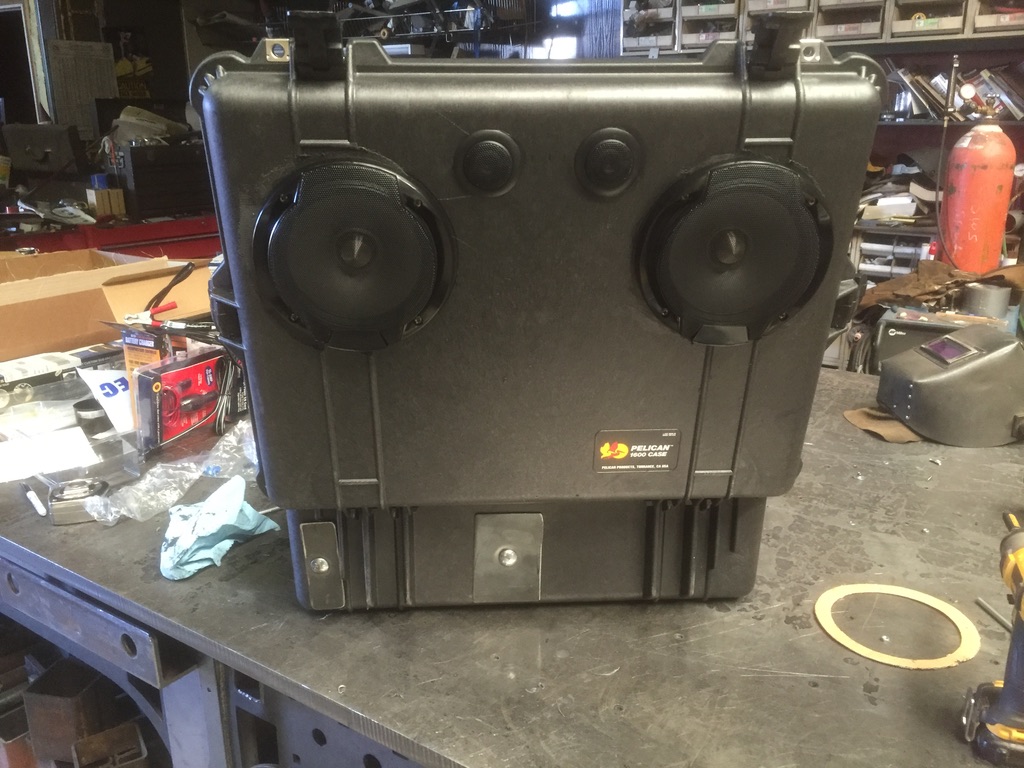
Real Sound. Built Tough. Ready For Anywhere.
Jobsite-ready Bluetooth audio that survives where consumer speakers die
Consumer Bluetooth speakers were not built for excavation crews. Drop one off the back of a UTV, leave it in the rain, or run it ten hours straight on a snow removal shift and you're buying a new one by next weekend.
This Pelican 1600 Boom Box solves that problem the right way. The enclosure is a genuine Pelican 1600 hard case — crushproof, dustproof, water-resistant, the same case rating that protects camera gear and rifles in the field. Inside lives a real car-audio system: Alpine SPR-60C component speakers with separate woofers, tweeters, and passive crossovers, driven by a Rockford Fosgate Prime amplifier off a sealed AGM battery sitting in a custom-welded steel cradle.
It pairs over Bluetooth, charges over USB, reads its own battery voltage, and runs all day. Marine-grade illuminated rocker switches handle power. Custom-cut louvered vents pull heat off the amp. And because the whole thing closes into a Pelican case with latches and a handle, you can throw it in a truck bed, an excavator cab, or a snow groomer and forget about it.
Built by Errol Kerr on a welding table in Truckee, CA. Field-tested at jobsites, off-grid camps, and the Dominican Republic.
Bottom line: Real component-speaker sound, sealed AGM power, military-grade case. Under $900 in parts.
Component breakdown and performance data
Every phase from parts on the bench to Bluetooth on Spotify
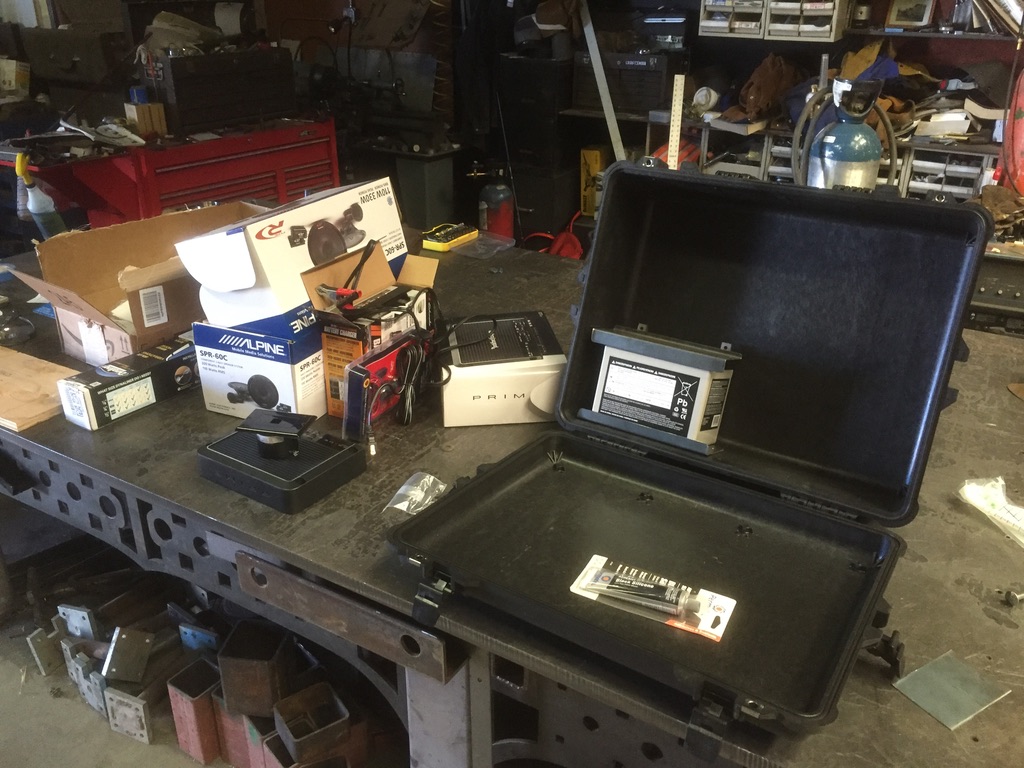
Pelican 1600 case, Alpine SPR-60C speaker box, Rockford Prime amp box, AGM battery, charger — full bill of materials before any cuts.
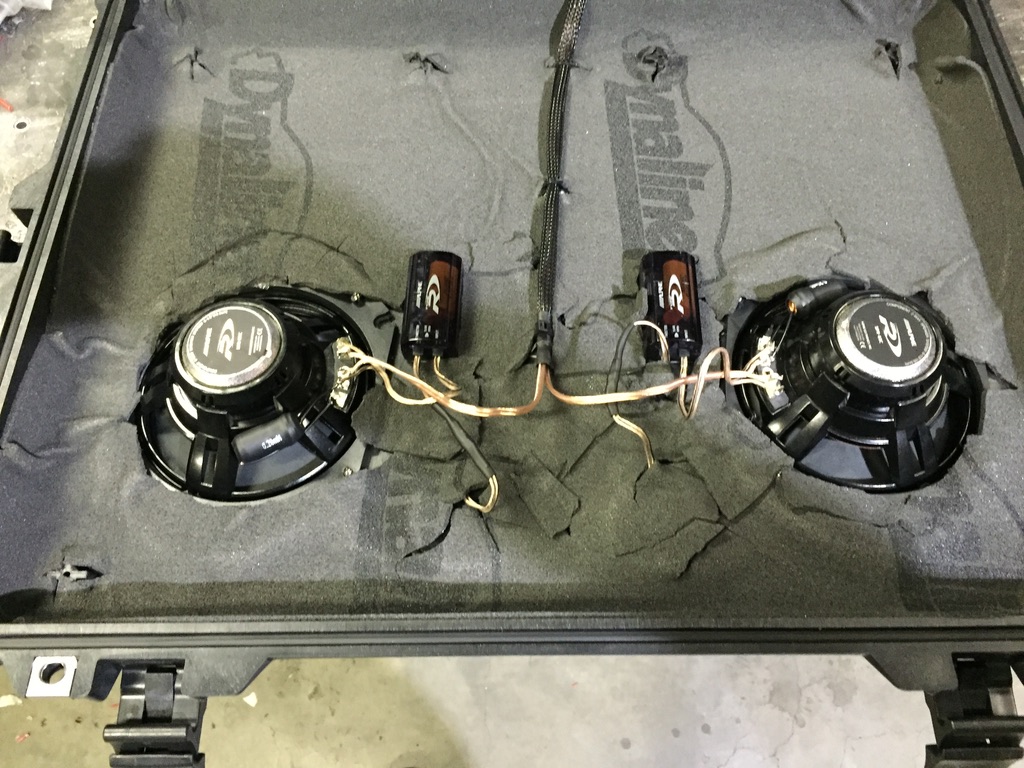
Back of the speaker panel: two Alpine 6.5" woofers, passive crossovers, copper wire harness, full Dynamat sound deadening.
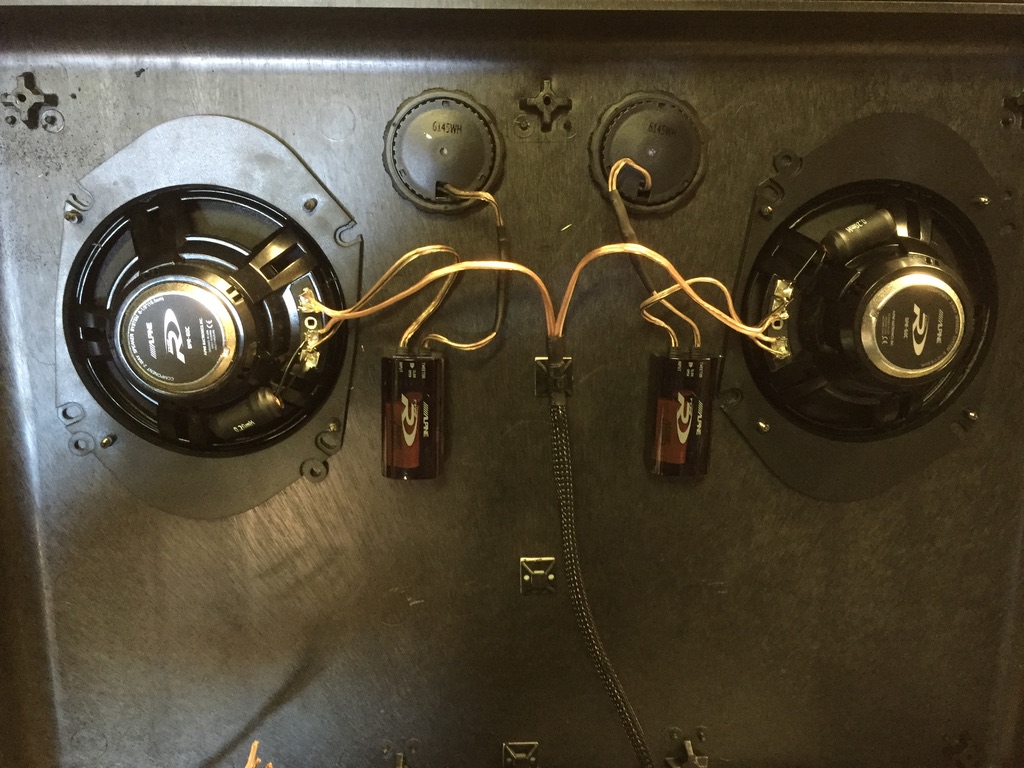
Detail shot: Alpine woofers, soft-dome tweeters between them, two crossovers, hand-routed wiring through a strain-relief grommet. Welded brackets secure the panel.
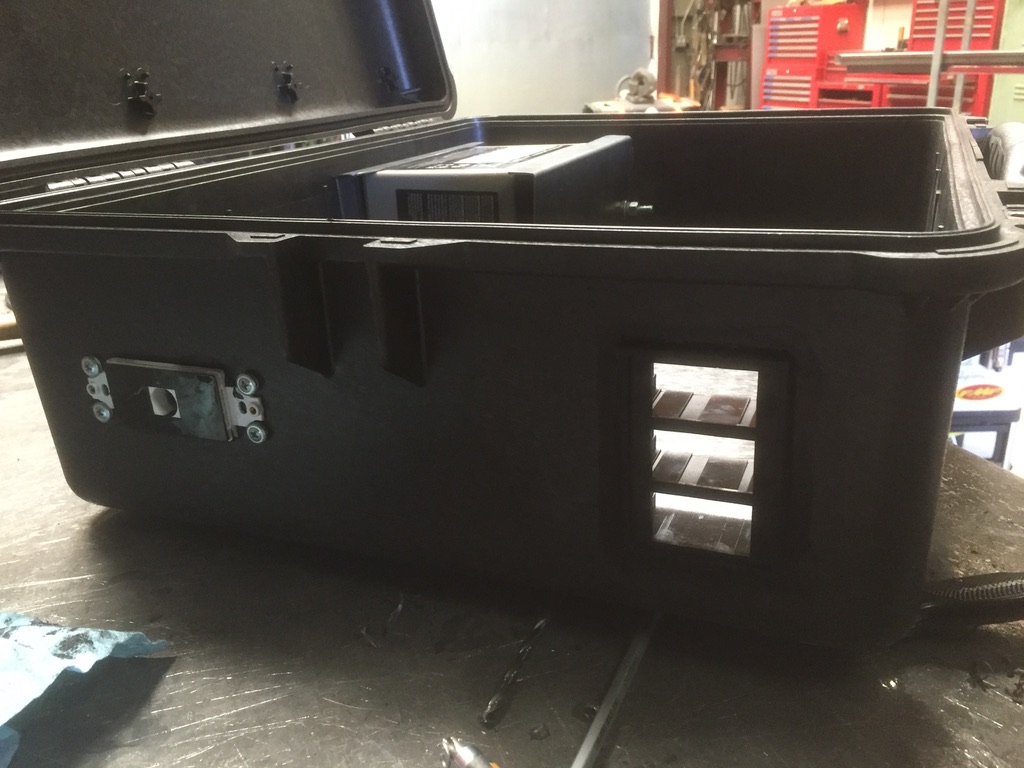
Three horizontal vent slots cut into the case side. Pulls heat off the amp without compromising case integrity.
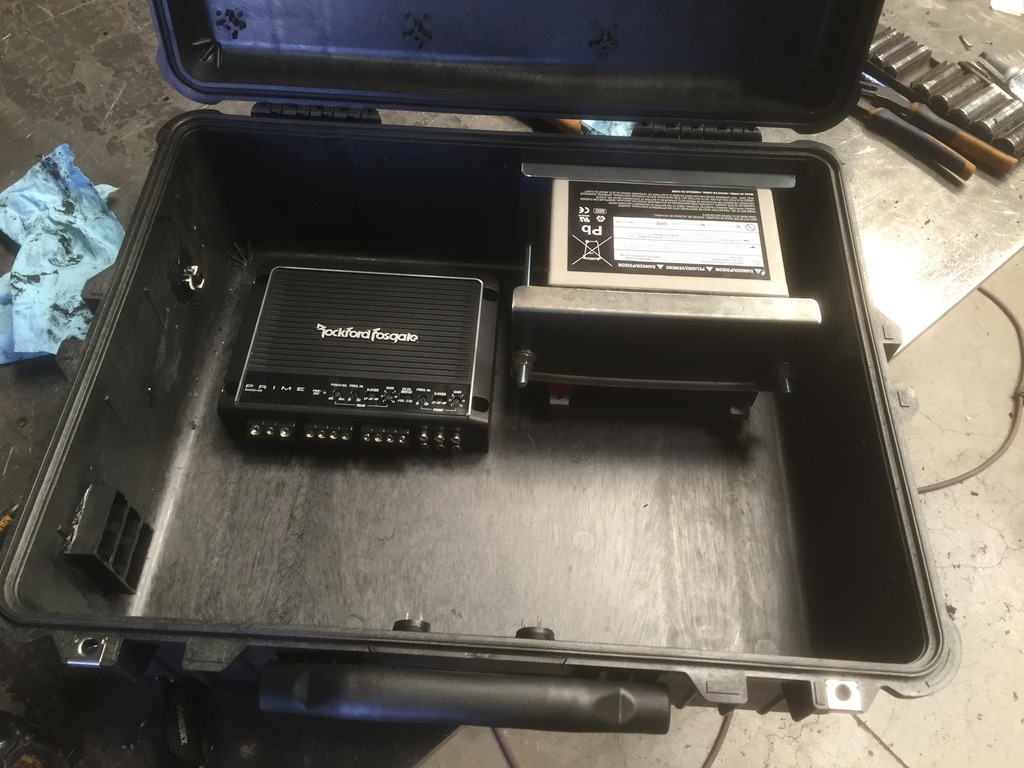
Rockford Fosgate Prime amp on the left, AGM battery on the right in a custom-welded steel cradle bolted to the case floor.
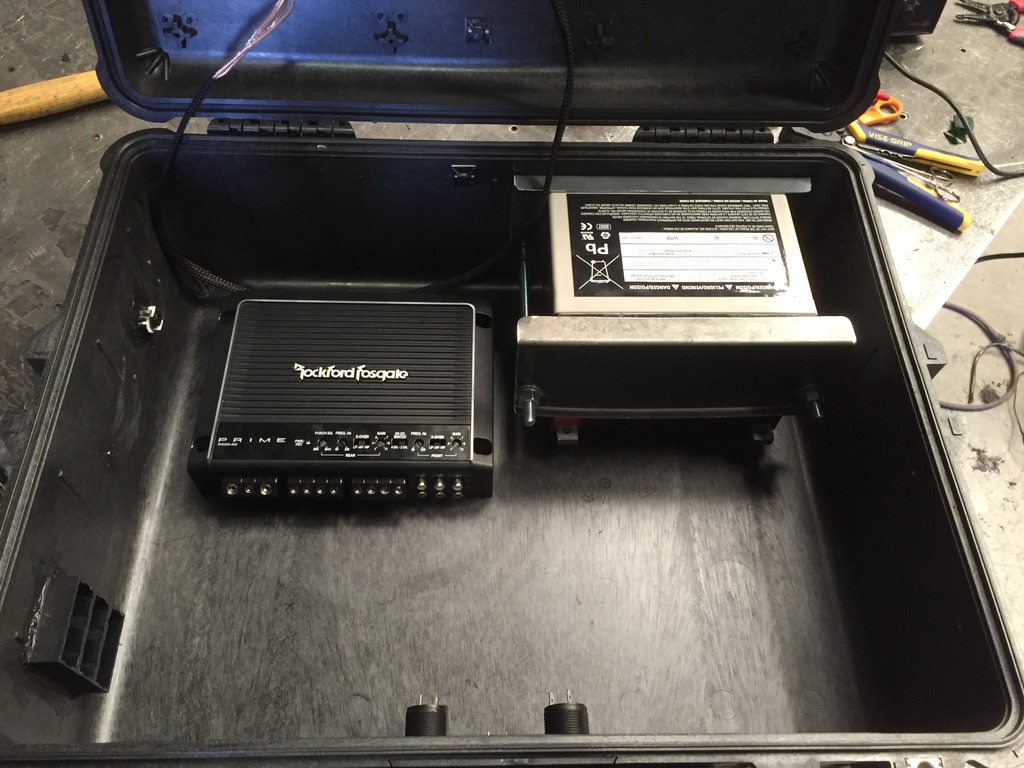
Side view showing how it all fits: amp, battery cradle, vent cutouts, and the switch panel mounting posts at the front.
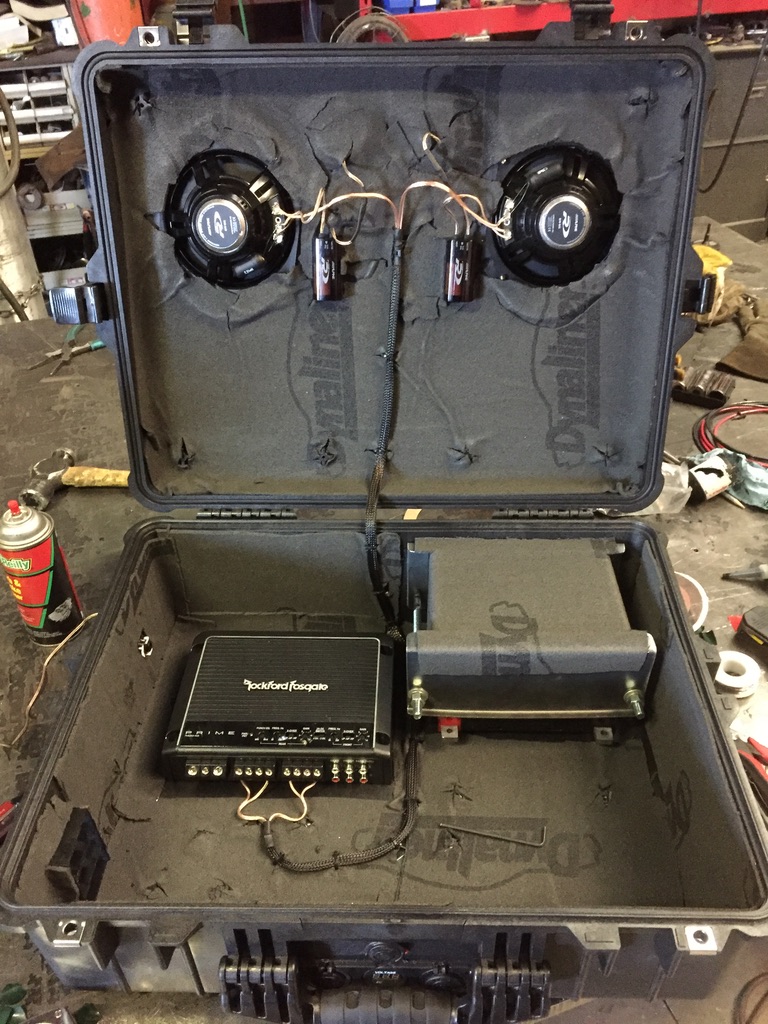
Both halves wired up: speakers and crossovers in the lid, amp and battery in the body. The flying-bridge wiring runs between the two through a sleeve.
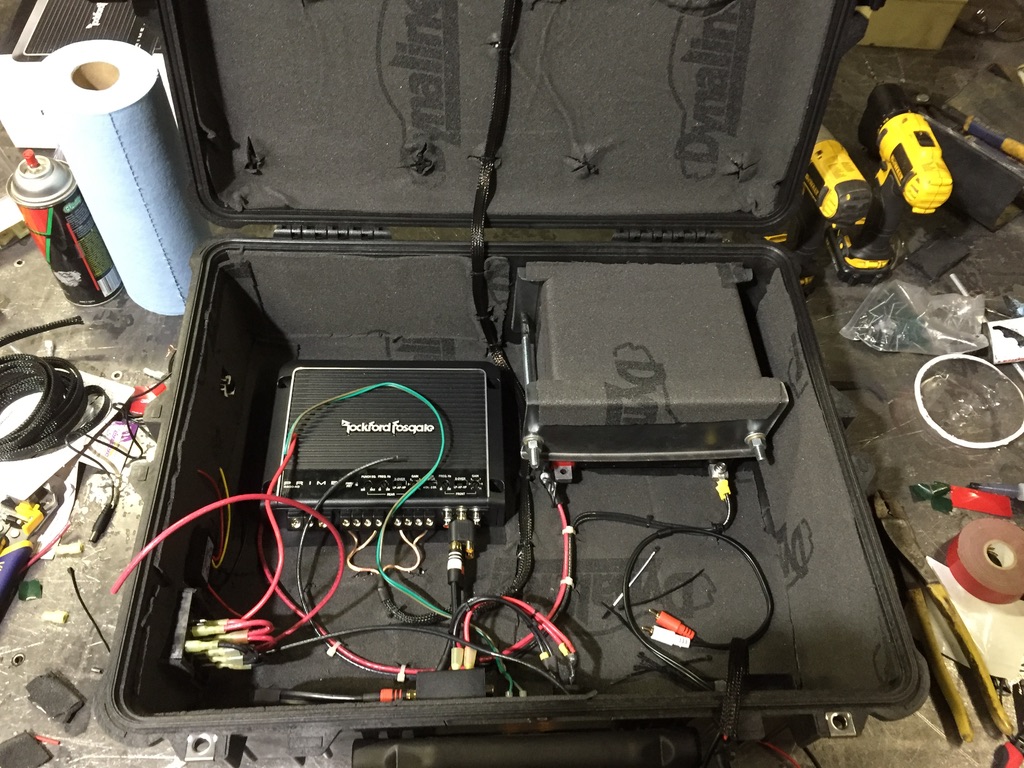
Harness coming together: power, ground, RCA, speaker pairs, all routed clean. Foam padding under the battery to absorb vibration.
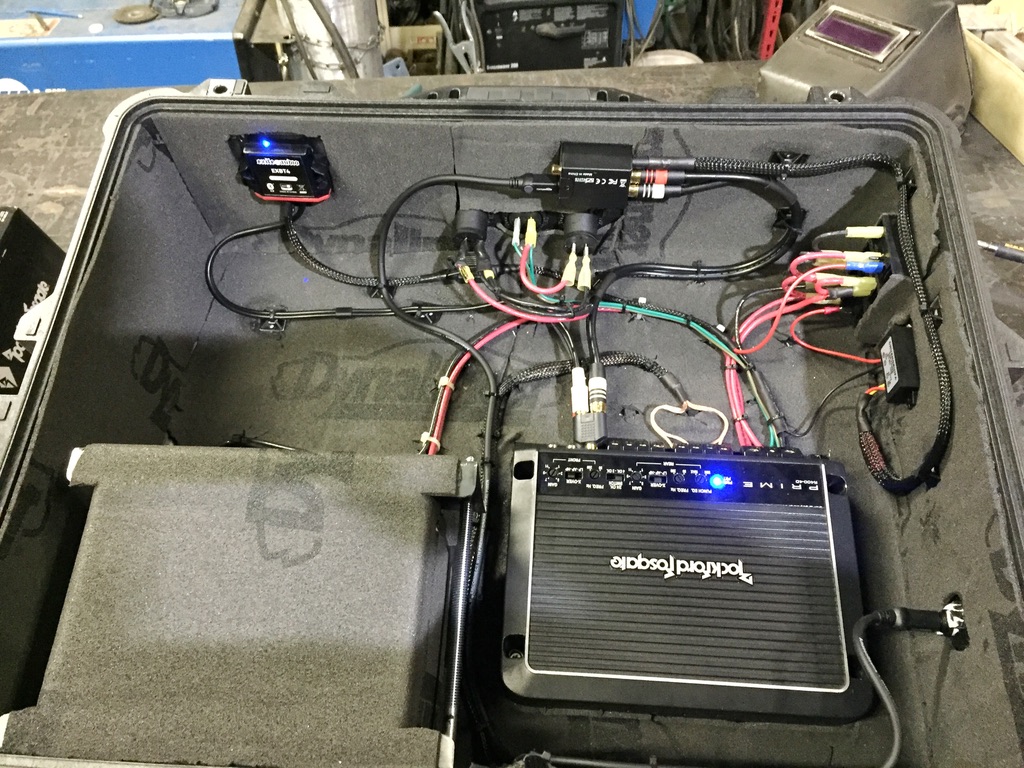
Bluetooth receiver mounted top-left, blue LED on. Wiring tidied with sleeve and ties. RCAs from BT into the amp inputs.
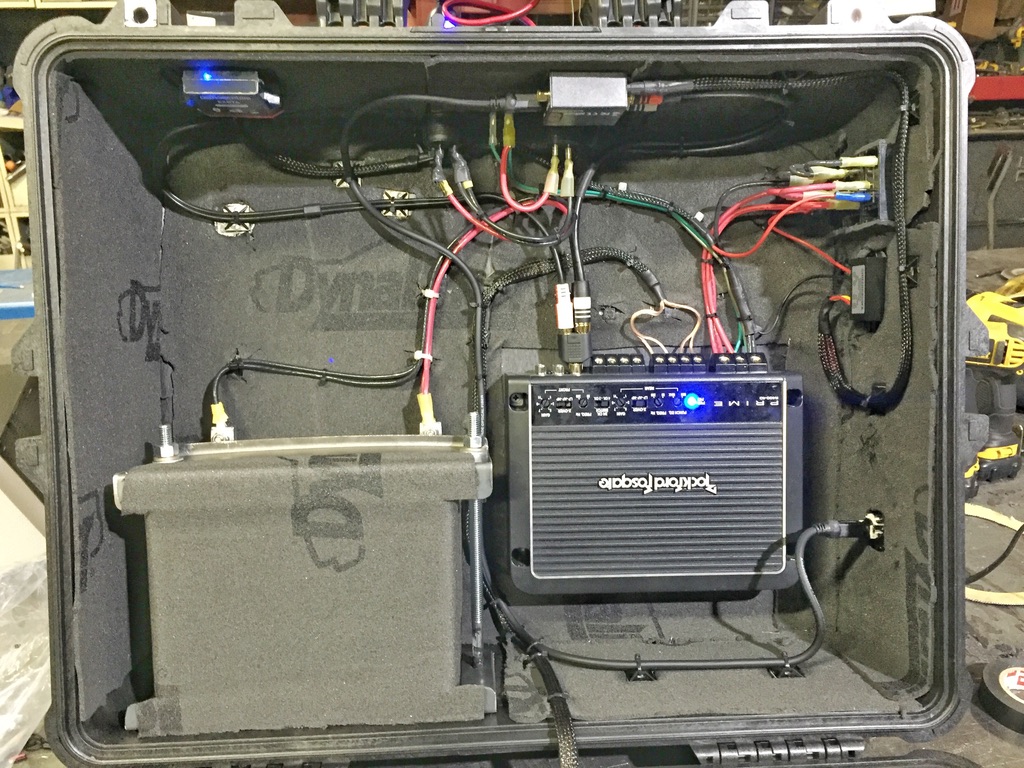
Final wiring pass. Every run labeled, fused, and dressed. Amp on, BT on, ready for the lid to close.
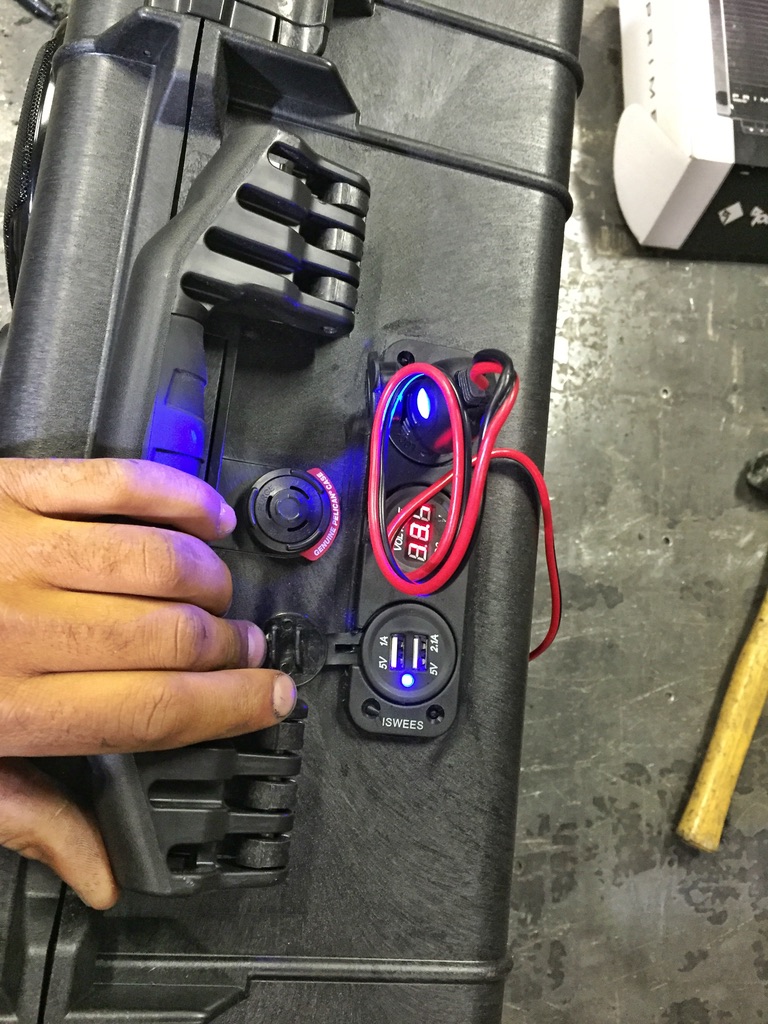
Digital DC voltmeter reading battery state at a glance. Dual USB port: 1A + 2.1A. Power lock socket above.
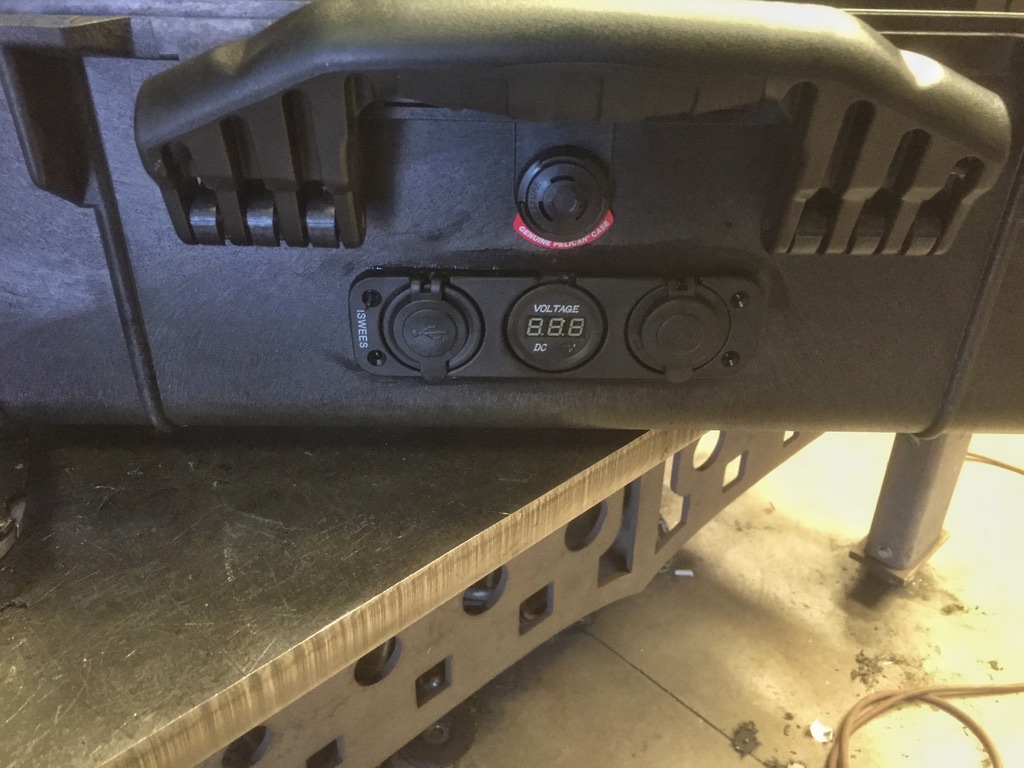
Power lock, voltmeter, USB charging — all surface-mounted on the case side under the locking handle. Recessed so the case still closes flush.
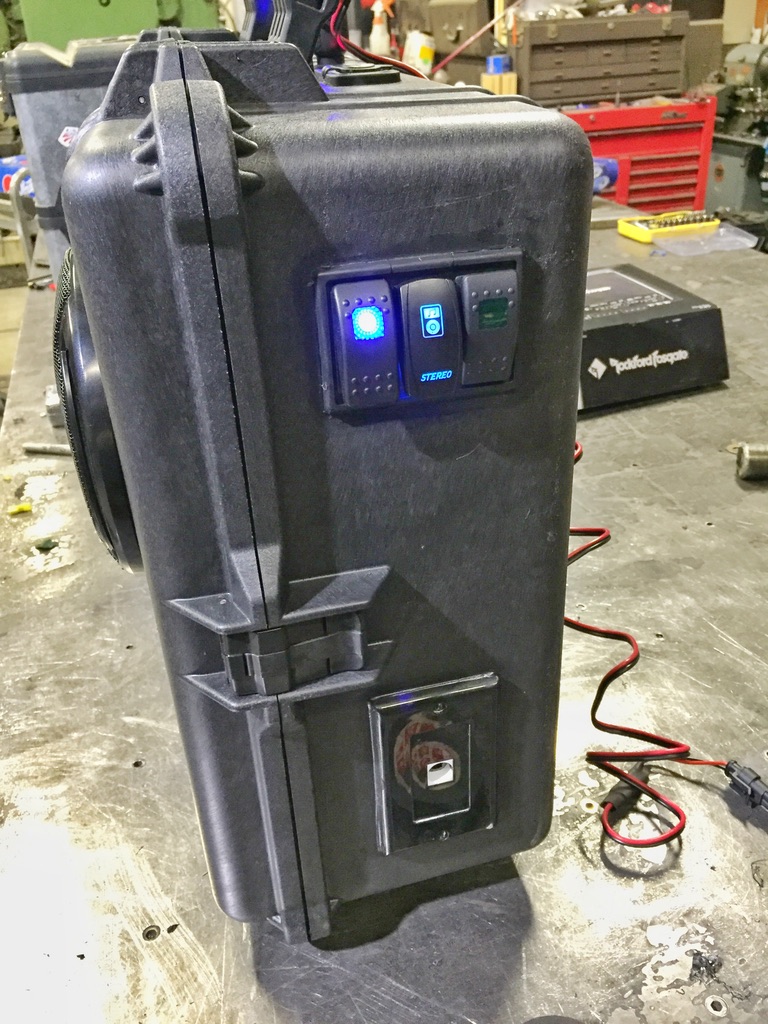
Marine-grade rocker switches lit blue. STEREO labeled. Same hardware you'd find on a center console.
Closed and ready. Two Alpine 6.5" component speakers, two tweeters, Pelican badge intact. Welding shop in the background.
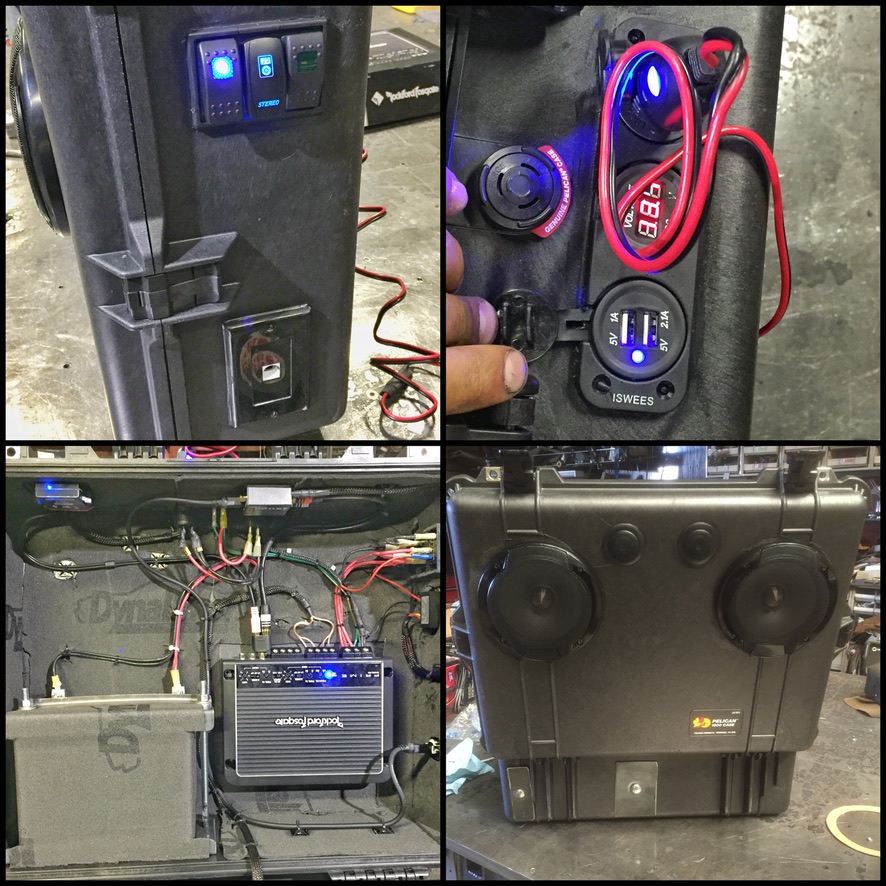
Four-up: lit switches, voltmeter and USB, full internal lit up, finished speaker face. The whole story in one frame.

Phone paired. Spotify playing OneRepublic over EXILE-BT. Proof of life — the build runs.
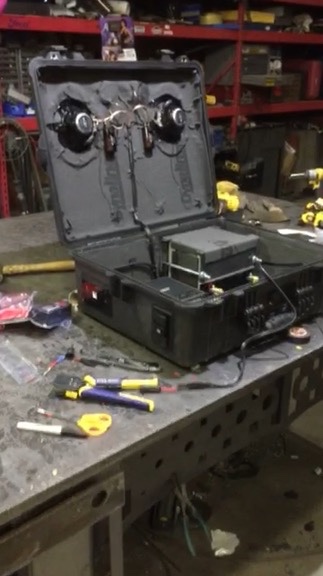
Open on the bench during a late-night listening test. Tools out, music up, working.
Every component used. Affiliate links go straight to Amazon — same parts, same brands.
Step-by-step, in the order I built it
Spread every component on a clean welding bench. Open the Pelican 1600 and dry-fit the amp and battery in the case body to confirm spacing. Mark speaker hole centers on the lid (Alpine 6.5" needs about a 5-3/16" cutout). Mark tweeter cutouts between the woofers. Mark the side-panel cutouts for switches, voltmeter, USB, and power lock. Mark the three louvered vent slots. Trace everything in pencil first, double-check, then commit.
Use a hole saw for the woofers, a step bit or smaller hole saw for the tweeters. Deburr all cuts. Apply Dynamat Xtreme to the entire interior of the lid before mounting any drivers — the deadening makes a bigger difference than people expect. Mount the Alpine woofers and tweeters from the front, secure with the included gaskets and screws. Mount the passive crossovers between them on the inside of the lid. Wire crossovers to drivers with the included pigtails.
Measure the AGM battery, add 1/4" clearance per side. Cut a flat-plate floor and four short square-tube uprights to box the battery in. Weld it up — stitch welds are fine, no need for full beads. The cradle gets through-bolted to the Pelican case floor with stainless hardware (drill, deburr, seal the bolt heads with marine sealant on the outside). Foam pad under the battery to absorb vibration.
Bolt the Rockford Fosgate Prime amp to the case floor opposite the battery. Run 8AWG power from the battery positive through an inline 30A fuse (within 18 inches of the battery) to the amp. Run 8AWG ground from the amp to the battery negative — short, fat ground is everything. Run RCAs from the Bluetooth receiver to the amp inputs. Run speaker wire from the amp to the lid through a sleeved harness with a strain-relief grommet. Crimp every terminal — no twist-and-tape.
Cut the side panel to fit illuminated rocker switches, the digital voltmeter, the dual USB port, and the power lock. Wire the rocker switches through 14AWG between battery positive and amp/accessory loads. Wire the voltmeter directly across the battery (constant read). Wire the USB port through a switched 5A circuit. Wire the power lock as a master kill switch on the battery positive lead — turn that off and the whole case is dead.
The amp will get warm under load. Cut three horizontal louvered slots in the case side near the amp — small enough to keep the case dust-resistant, large enough to let heat out. A jigsaw with a fine-tooth blade is your friend. Deburr the cuts and seal the inside edges with weatherstrip foam to keep moisture out while letting air move.
Charge the AGM to a full 12.8V on the maintainer. Power the case on with the master switch. Pair your phone to "EXILE-BT" over Bluetooth (no password). Run music up to 75%, listen for any rattle or buzz — fix anything that resonates with extra Dynamat. Leave it on for an hour and watch the voltmeter. If it sags below 11.8V too fast, the battery's tired and needs a recharge. Once it passes the run test, close the case, latch it, and call it done.
Real-world results from the build
Separate woofers, tweeters, and crossovers. Crisp highs, present mids, tight low end — sounds like a car system because it is one.
AGM battery runs the system for hours of normal-volume listening between charges. Float charger keeps it topped up between use.
Pairs as "EXILE-BT" with any phone, tablet, or laptop. No app, no proprietary nonsense, no subscription.
Crushproof, dustproof, water-resistant. Throw it in a truck bed or a UTV. The case rating is the same one used for camera and rifle gear.
Dual USB port (1A + 2.1A) on the side. Plays music and charges two phones at the same time. Voltmeter shows you what's left.
Every component standard automotive or marine hardware. Every part replaceable from Amazon or a local audio shop. Nothing proprietary.
Every part has an Amazon link above with our affiliate tag. Buy what you need, fire up the welder, and put together your own. Tag @errolkerr if you do — we want to see it.
Start Shopping PartsGot questions about this build? Tips to share? Built your own version? Drop a note — real builders, real answers.